Saturday, January 28, 2017

Click here and enjoy 👇

http://www.iniroots.com/?ref=39875

Wednesday, January 25, 2017

https://www.cpagrip.com/show.php?l=0&u=100015&id=7916&tracking_id=

Saturday, January 14, 2017


Samsung Galaxy S6 vs Sony Xperia Z3+ : design et conception

androidpit galaxy s6 vs xperia z3 plus comparison 10
Le round  1 commence ! © ANDROIDPIT
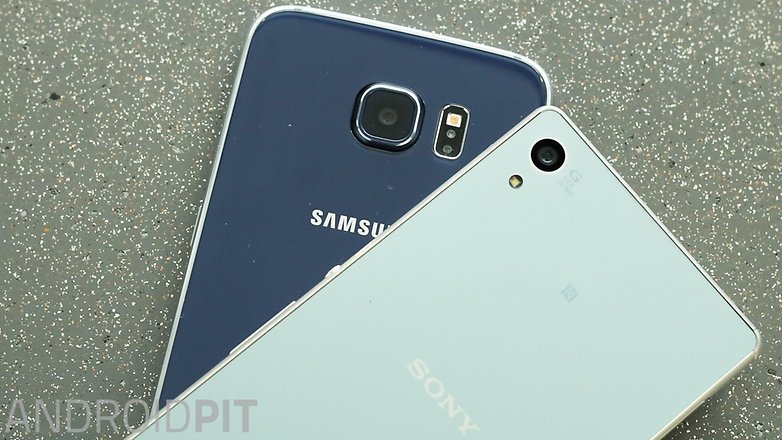
Le verre et le métal sont les matériaux les plus utilisés pour cette année 2015 (en particulier chez Sony). Les deux terminaux ont suivi le pas et nous offrent tous les deux une armature en métal avec un dos en verre, qui est par ailleurs très agréable à prendre en main.
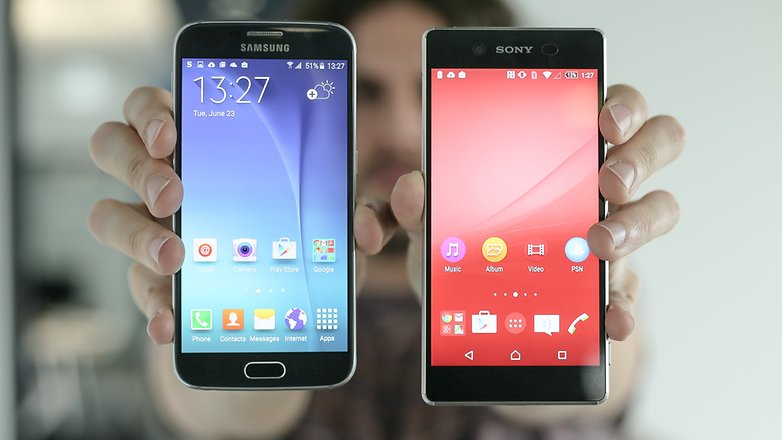
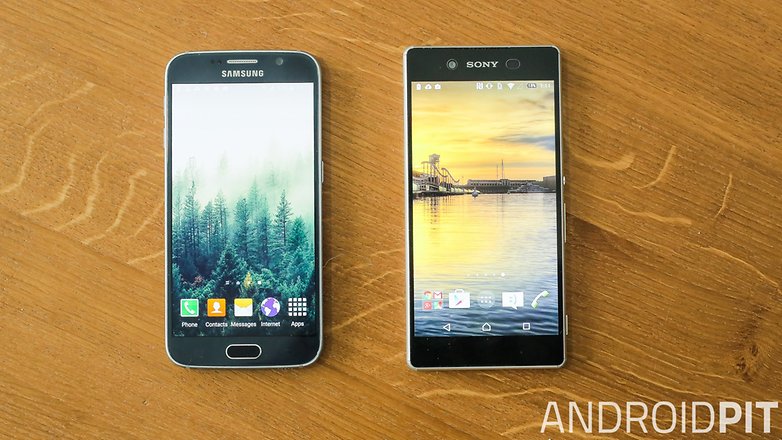
Le Galaxy S6 et l'Xperia Z3+ (connu sous le nom d'Xperia Z4 en Asie) sont similaires : les matériaux, la taille, l'épaisseur et le poids sont quasiment identiques (pour plus de précision sur sa fiche technique est disponible dans cet article). La principale différence entre les deux smartphones est bien évidemment la forme.
androidpit galaxy s6 vs xperia z3 plus comparison 3
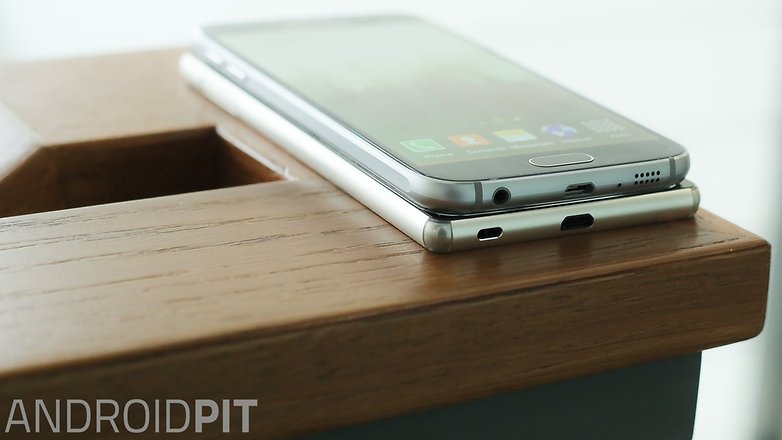
Les deux smartphones sont super fin. © ANDROIDPIT
Les courbes du Galaxy S6 sont plus rondes que celle du Z3+ qui a une dalle carrée avec une apparence proche de son grand frère, le Xperia Z3. Les deux ont la vitre arrière et les côtés en aluminium, mais le Xperia Z3+ est le seul qui profite de la norme IP68 contre la poussière et est résistant à l'eau. Notez que son port de charge n'a plus besoin d'être couvert puisqu'il est totalement étanche.
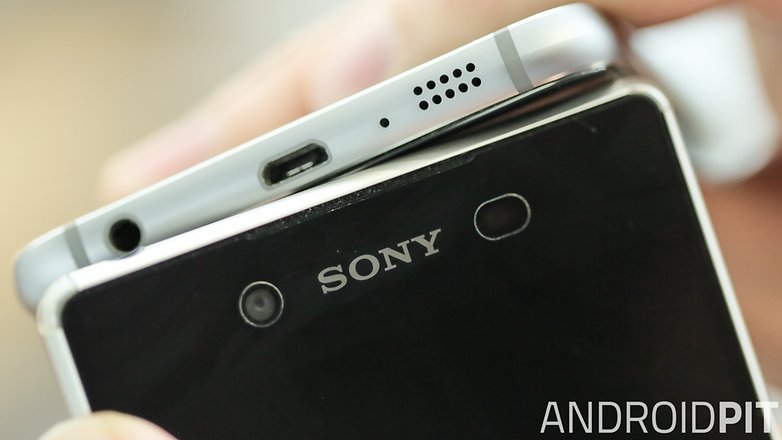
Le Galaxy S6 dispose d'un seul haut-parleur sur le haut alors que le Xperia Z3+ dispose de deux haut-parleurs subtilement cachés en haut et en bas de la face de l'écran.
Les deux appareils sont agréables à tenir en main et ont un esthétisme fort agréable. Si vous hésitez, encore, sachez que seul le Z3+ a la norme IP68.

Samsung Galaxy S6 vs Sony Xperia Z3+ : qualité écran

Ces deux téléphones disposent d'écran remarquables. En terme de chiffres, le Galaxy S6 dispose d'un QHD (2560 x 1440 pixels) Super AMOLED avec 577 pixels par pouce et le Xperia Z3+ lui dispose d'un Full-HD (1920 x 1080 pixels) écran LCD IPS avec 424 ppi.
Le Galaxy S6 se place devant le Z3+ au niveau de l'affichage, avec de meilleurs angles de vision et les couleurs y sont plus chaudes.
androidpit galaxy s6 vs xperia z3 plus comparison 5
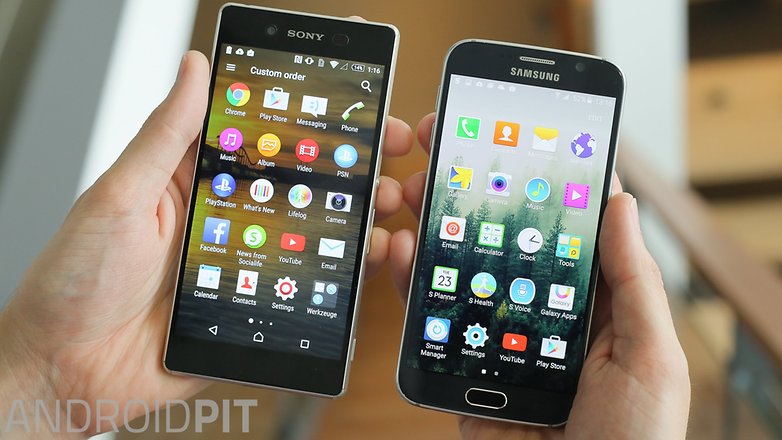
Les couleurs sont d'une meilleurs resemblance sur le Z3+. © ANDROIDPIT
Même si le Xperia Z3+ manque de densité de pixel, il gagne en luminosité : il dispose d'un affichage lumineux et offre une belle visibilité à l'extérieur.
On sait tous que  le Galaxy S6 possède l'un des meilleurs écrans sur le marché. Toutefois, le Xperia Z3+ ne reste pas en retrait et emploie quelques grandes technologies telles que TRILUMINOS, X-Reality, et Live Color LED pour améliorer son affichage . 
androidpit galaxy s6 vs xperia z3 plus comparison 1
L'Xperia Z3+ a de l'avance sur le S6 au niveau de l'écran. © ANDROIDPIT

Samsung Galaxy S6 vs Sony Xperia Z3+ : appareil photo

Parlons à présent de la caméra. Le Galaxy S6 possède l'un des capteurs photos des plus hautement détaillés disponible sur le marché. Avec 16 mégapixels, combinés avec la stabilisation d'image optique, l'autofocus et le flash LED, le capteur photos a la capacité de produire de très belles photos dans toutes les conditions d'éclairage.

L'appareil photo principal du Xperia Z3+ compte environ 20 millions de pixels, avec un 25 mm lentille grand-angle super-large (qui le rend idéal pour les paysages), ainsi que l'autofocus et le flash LED.
androidpit galaxy s6 vs xperia z3 plus comparison 9
Une caméra arrière de 20,7 mégapixels pour le Xperia Z3+ (à droite) et 16 Mégapixels pour leGalaxy S6. © ANDROIDPIT
Sur le devant de l'appareil  le Galaxy S6 dispose d'un appareil photo de 5 mégapixels et d'un capteur vidéo qui filme à 30 images par seconde, avec une double fonctionnalité d'appel vidéo et HDR automatique. Le Xperia Z3+ possède un appareil photo 5,1 mégapixels qui capture des vidéos en 1080 pixels à 30 images par seconde et intègre la fonctionalité HDR.
Le Z3+ souffre d'un problème de surchauffe qui bloque  l'appareil  dans certaines circonstances. Lors de l'utilisation d'effets AR, ou lorsque vous filmez une vidéo 4K, l'appareil risque de surchauffer et l'application de la caméra va se fermer 20 secondes plus tard. 
Heureusement, Sony a trouvé solution au problème et une mise à jour Over-The-Air (OTA) corrigeant partiellement le problème est actuellement en cours de déploiement. Cela dit, il faudra attendre encore un peu avant que le problème soit totalement résolu.

Samsung Galaxy S6 vs Sony Xperia Z3+ : performances

Le Galaxy S6 embarque un processeur Exynos 7420 fabriqué par Samsung, tandis que le Sony Xperia Z3+ est livré avec un Qualcomm : Snapdragon 810.

Cette version du Snapdragon 810 est plus rapide que l'originale 810 (qui est encore présente sur le LG G Flex 2 et HTC One M9). Notez que  le Xperia Z3+ est toujours aussi  chaud en main dans certaines conditions (comme lors de l'utilisation de l'appareil photo, comme décrit ci-dessus). Les deux appareils disposent de 3 Go de mémoire RAM et sont extrêmement performants.
androidpit galaxy s6 vs xperia z3 plus comparison 11
Le Z3+ dispose de deux hauts parleurs sur le devant de l'appareil. © ANDROIDPIT
L'une des particularités du Xperia Z3+ est d'embarquer un emplacement MicroSD. La mémoire du Xperia Z3 + peut être étendue jusqu'à 200 Go.

Samsung Galaxy S6 vs Sony Xperia Z3+ : batterie / autonomie

Le Xperia Z3 a fait forte impression pour sa durée de vie, mais il manquait certaines fonctionnalités comme la charge rapide et le rechargement sans fil. Cette fois ci , Sony n'a pas refait deux fois la même erreur, car  le Z3+ est livré avec les fonctionnalités Qualcomm Fast Charge 2.0 qui  lui confère environ 5 heures d'autonomie pour une charge de 10 minutes. Le Z3+ tient largement plus d'une journée avec une seule charge.
Le Galaxy S6 abrite une fine batterie de seulement 2550 mAh.Il abrite également des fonctionnalités intéressantes tout comme le Z3+ : charge rapide, rechargement sans fil. 
androidpit galaxy s6 vs xperia z3 plus comparison 12
La batterie est l'un des éléments principaux du smartphone. © ANDROIDPIT
Bien que le Xperia Z3+ ne possède pas la technologie du rechargement sans fil, il n'en reste pas moins très bon élève  pour ce qui est de l'autonomie.

Samsung Galaxy S6 vs Sony Xperia Z3+ : caractéristiques techniques

 SAMSUNG GALAXY S6SONY XPERIA Z3+
MODÈLE :SM-G920Xperia Z3+
CONSTRUCTEUR :SamsungSony
DIMENSIONS :143,4 x 70,5 x 6,8 mm146 x 72 x 6,9 mm
POIDS :138 g144 g
CAPACITÉ DE LA BATTERIE :2550 mAh2930 mAh
TAILLE D'ÉCRAN :5,1 pouces5,2 pouces
TECHNOLOGIE D'ÉCRAN :AMOLEDLCD
ECRAN :2560 x 1440 pixels (576 ppp)1920 x 1080 pixels (424 ppp)
APPAREIL PHOTO AVANT :5 Mégapixels5 Mégapixels
APPAREIL PHOTO ARRIÈRE :16 Mégapixels20,7 Mégapixels
FLASH :LEDLED
VERSION ANDROID :5.0.2 - Lollipop5.0 - Lollipop
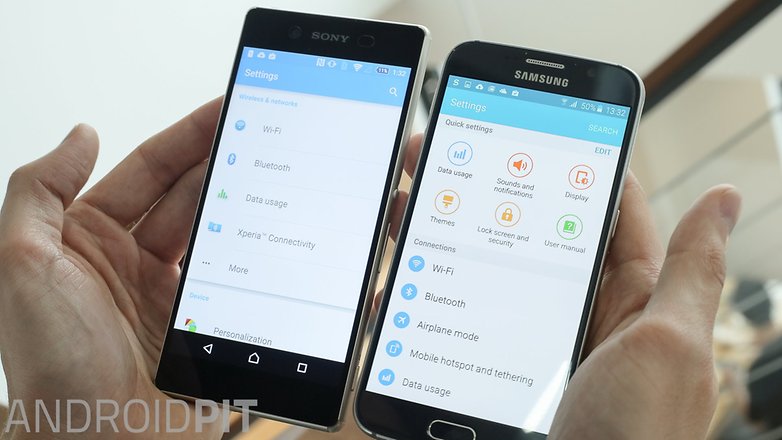
INTERFACE UTILISATEUR :TouchWizXperia UI
RAM :3 Go3 Go
MÉMOIRE INTERNE :32 Go
64 Go
128 Go
32 Go
MÉMOIRE AMOVIBLE :Non disponiblemicroSD
CHIPSET :Samsung Exynos 7420Qualcomm Snapdragon 810
NOMBRE DE COEURS :88
FRÉQUENCE D'HORLOGE MAXIMALE :2,1 GHz2 GHz
CONNECTIVITÉ :HSPA, LTE, NFC, Bluetooth 4.1HSPA, LTE, NFC, Bluetooth 4.1

Samsung Galaxy S6 vs Sony Xperia Z3+ : verdict

Les appareils de Sony sont largement sous-estimés et Samsung s'en frotte les mains . En effet, Le Xperia Z3 + est si semblable à son homologue 2014. Bien que le processeur Snapdragon 810 soit plus rapide pour le  consommateur lambda  cela n'est pas visible .
En comparant les deux fiches d'identité  de ce qui pourrait être un des meilleur téléphone Android à l'heure actuelle, on peut juste noter que la gamme Galaxy avec le  S6 souligne quelques lacunes. Son rival avec son autonomie, sa résistance à l'eau, son port MicroSD tient la tête du classement. 
Et vous, qu'en pensez vous ? Galaxy Samsung S6 ou Sony Xperia Z3+ ? Les commentaires restent ouverts !

Wednesday, January 11, 2017


Bragi Eyes iPhone 7 With New Wireless Earbuds

Bragi takes advantage of the iPhone 7 headphone jack rumors with The Headphone.


Ahead of Apple's Wednesday iPhone event, where Cupertino might introduce a smartphone that lacks a headphone jack, a number of accessory makers have introduced gadgets that take advantage of that adjustment. The latest is Bragi with The Headphone, which are, in fact, not headphones but wireless earbuds that sync with any Bluetooth device to play music and facilitate phone calls.
"The Headphone is Bragi's answer to what happens when Apple and other mobile companies ditch the headphone jack for good," CEO Nikolaj Hviid said in a statement.
The Headphone can block ambient sound and works for up to six hours (250 hours on standby); charge them up in less than two hours. Choose between small, medium, and large for the best fit.
The Headphone will retail for $149; early bird buyers, however, can pre-order the accessory online through Nov. 1 for a discounted price of $119.
Those who participated in the Kickstarter campaign for the Bragi Dash, another wireless audio product from the company, can also get an extra $20 off via an emailed coupon. For more, see PCMag's review of the Bragi Dash.
Bragi also announced a Dash software update, making the micro-wearable computers "smarter, faster, and better in several areas," including Bluetooth connectivity and language understanding. It also now synchronizes with Google Fit and the Apple HealthKit.

Apple AirPods Finally Go on Sale

Better late than never. The $159 wireless earbuds should arrive by Dec. 21.

After delaying shipments of its new wireless AirPods back in October, Apple is finally ready to get these things in people's ears.
Cupertino on Tuesday announcedthat its $159 wireless headphones are available online today and will arrive in stores next week. Those who order them online now can also expect them by Dec. 21.
"AirPods will be shipping in limited quantities at launch and customers are encouraged to check online for updates on availability and estimated delivery dates," Apple wrote on its website. "Stores will receive regular AirPod shipments."
The AirPods are tiny white earbuds that each sport an inch-long stem. They come in a smooth white case with a flip-open top that doubles as a charger. AirPods last five hours, but the case can give it about four extra charges, for a total of 24 hours.
The pricey wireless ear buds are available in more than 100 countries and territories, including the US, UK, Canada, Australia, China, Hong Kong, France, Germany, India, Mexico, Netherlands, Japan, and UAE. Just remember, in order to use them you'll need an Apple device running that latest version of iOS 10, watchOS 3, or macOS Sierra.
PCMag's Sascha Segan got some hands-on time with AirPods in September at Apple's iPhone 7 unveiling event, and said they're "unique in the Bluetooth headphone market, both for their form and their mysterious technology." He said they're comfortable and sound great but pointed out how easy they are to lose.
As for the delay, an Apple spokesperson told the Wall Street Journal in late October that the wireless headphones just weren't ready. "We don't believe in shipping a product before it's ready, and we need a little more time before AirPods are ready for our customers," the spokesperson said.
AirPods run a new W1 chip, as do three new Beats products: the Beats Solo 3 Wireless, PowerBeats 3 Wireless, and the new Beats X. Unfortunately, Beats X are not yet available; a note on theproduct page says the $149.95 device will ship in February,Engadget notes.

Canon Unveils PowerShot G9 X Mark II Compact Camera

LAS VEGAS—Canon's pocket-sized 1-inch camera, the G9 X, proved to deliver excellent images when we reviewed it, but was sluggish when shooting in Raw mode. Canon is updating it with a faster processor in the form of the G9 X Mark II, and promises that the new version will speed along and capture images at 8.2fps regardless of whether you shoot in Raw or JPG format.
CES 2017 BugAside from that, the new model is largely the same as the first iteration. It's a very small camera with a comparatively huge 1-inch image sensor, 20MP resolution, and a 28-84mm (full-frame equivalent) f/2-4.9 zoom lens. It doesn't have as long of a range as its more expensive sibling, the G7 X Mark II, but it remains a strong option for photographers who can live with a limited zoom and want a pocket model that will run circles around smartphones when it comes to image quality.
Wireless transfer is available, with both Wi-Fi and Bluetooth built-in for quick connection to a smartphone and fast transfers. This lets you take your better-than-smartphone snaps and beam them over to your Android or iOS device so you can share images on Facebook or Instagram when out and about.
Video is limited to 1080p, although there is a built-in time-lapse movie function. The G9 X Mark II is priced at $529.99 and will go on sale in February.
Canon Vixia HF R80
Canon is offering minor updates to its Vixia camcorder line for 2017. The new models, HF R82, R80, and R800, are pretty much the same camcorders as the R72, R70, and R700 that came before them. New features include Flexible Slow and Fast Motion capture, backlight correction, Highlight Priority metering, and compatibility with the Canon Camera Connect app. If you were hoping for 4K models from Canon, keep hoping—the Vixias top out at 1080p. They're priced at $449.99, $399.99, and $299.99 respectively and will ship in February.
Finally, the G7 X Mark II is now being offered as part of a Video Creator Kit. It includes the camera, a spare battery, a Manfrotto PIXI tripod, and a 32GB memory card. The cost is $749.99 and the bundle will start to ship in February.

Un positionnement pas inintéressant

Disponible depuis quelques semaines en Asie, le Galaxy J5 vient de faire son apparition sur les sites de plusieurs e-marchands européens, dont Amazon. Son grand frère, le Galaxy J7, devrait le suivre de près.

Samsung Galaxy J5


a fiche technique du Galaxy J5 est très similaire à celle du nouveau Moto G présenté ce mardi. L'engin arbore un écran de 5 pouces en définition HD (soit une résolution de 293 ppp), mais de technologie Super AMOLED. Il embarque un SoC Snapdragon 410 dont les 4 cÅ“urs d'architecture Cortex A53 sont cadencés à 1,2 GHz. Celui-ci est naturellement associé à un GPU Adreno 306, tandis que Samsung a prévu 1,5 Go de mémoire vive pour faire tourner au mieux Android 5.1 (Lollipop). La mémoire interne, de son côté, se décline en 8 et 16 Go, sachant qu'un port microSD est présent et permet d'ajouter 128 Go supplémentaires.


Sur le front de la photo, le terminal s'arme de deux APN de 13 et 5 Mpx. Étonnamment, Samsung précise que le Galaxy J5 est son premier smartphone doté d'un flash en façade, et ce afin de faciliter les selfies en basse luminosité. La connectivité, de son côté, se montre relativement complète, avec un menu composé de 4G (catégorie 4 ; jusqu'à 150 Mb/s), de Wi-Fi b/g/n, de Bluetooth 4.1, de NFC et de GPS. L'indice DAS culmine pour sa part à 0,61 W/kg, tandis qu'une batterie de 2 600 mAh se charge d'alimenter le tout. Dimensions de l'appareil : 142,1 x 71,8 x 7,9 mm, pour 146 g. Son prix de lancement est de 229 €.


Présenté en même temps que le Galaxy J5, le Galaxy J7 est un autre modèle de milieu de gamme, mais plus orienté vers les amateurs de phablettes. Pourvu d'une dalle de 5,5 pouces, elle aussi de technologie Super AMOLED, il fait malheureusement l'impasse sur la définition Full HD pour se contenter d'une simple HD. Il est résulte une définition honnête, mais sans plus, de 267 ppp. Derrière cet écran, on trouve un autre SoC Qualcomm, à savoir le Snapdragon 615. Doté de 4 cÅ“urs Cortex A53 cadencés à 1,5 GHz et de 4 autres cÅ“urs Cortex A53 cadencés à 1 GHz, il s'associe à un GPU Adreno 405 et à 1,5 Go de mémoire vive pour animer Android, encore une fois en version Lollipop. 16 Go de mémoire interne et un port microSD se chargent du stockage.

Pour ce qui est de la photo, le Galaxy J7 embarque très probablement le même équipement que le Galaxy J5, comme en témoignent les deux APN de 13 et 5 Mpx ainsi que le flash en façade. La connectivité est également issue du même tonneau, avec une compatibilité 4G de catégorie 4, le Wi-Fi b/g/n, le Bluetooth 4.1, le NFC et le GPS. La batterie passe tout de même à 3 000 mAh. Les dimensions, de leur côté, sont de 152,5 x 78,7 x 7,1 mm pour 171 g. Quant au prix de vente conseillé en Europe, il n'a pas encore été divulgué. On peut toutefois parier qu'il se situera un peu sous la barre des 300 €, sous peine de confrontation très difficile avec des ténors comme le G3 ou le Zenfone 2 ZE551ML.

OUR VERDICT

ZTE Axon 7 is less expensive than the best flagship smartphones, yet it looks and performs like a top-tier Android Marshmallow handset, with front-facing speakers, 64GB of storage and only a few sacrifices.

FOR

  • Inexpensive yet well-designed
  • Generous 64GB of internal storage
  • Awesome dual front-facing speakers

AGAINST

  • Slippery in the hand
  • Not on all US carriers
  • Doesn't match Samsung's camera

ZTE Axon 7 dealswith a sleek design, powerful specs and a reasonable unlocked price, which challenges the Samsung Galaxy S7 Edge and iPhone 7.

And that last fact explains the confusing name of this successor to last year's ZTE Axon Pro (ZTE Axon Elite in the UK); ZTE has skipped right over the Axon 2 through Axon 6 between 2015 and 2016.
The Chinese phone-maker is ambitiously trying to compete with the top phone manufacturers from the US and South Korea, so much so that it designed the phone outside of China, in the US.
ZTE Axon 7
What we end up with is an Android Marshmallow smartphone with a polished metal design, rich-looking Quad HD display, booming front-facing speakers, and a load of software customizations of the kind often found in a more expensive handset.
That's not all. It won't be long before the Axon 7 is updated to Android Nougat, and ZTE is touting it as the first phone compatible with Google Daydream VR, which is technically true – we're just waiting for Android 7.1 Nougat, which debuted with the Google PixelGoogle Pixel XL andGoogle DayDream View VR headset, to make that happen.
ZTE Axon 7
The ZTE Axon 7 doesn't outclass Samsung's top-of-the-line camera in the Samsung Galaxy S7, or the elegantly curved look of the Galaxy S7 Edge – but it does come really, really close for the price.
It's not quite inexpensive enough to make it onto our best cheap phones list, but it does now feature on TechRadar's updated best phones list. Let's break down why that is.

Release date and price

The ZTE Axon 7 release date was July 27 in the US, it came to the UK and the rest of Europe in September, and finally launched in Australia in late November. You just won't find it everywhere, including in US carrier stores.
ZTE Axon 7
You have to buy this phone unlocked on Amazon or another retailer and pay full price. It won't be sold at US carriers like AT&T, T-Mobile, Verizon or Sprint and you shouldn't expect price subsidies.
While it technically has enough bands to support all US phone networks, it only works with AT&T and T-Mobile nanoSIM cards right now. Verizon and Sprint compatibility is due "possibly later in the year", essentially requiring the two CDMA carriers to flip a switch. All of the antennas are inside – this isn't just a GSM phone.
The good news here is that if it works with your carrier, the ZTE Axon 7 is available at an attractive price. Packed with 64GB of internal storage it costs $399 (£359, AU$699). Plus, you won't have to deal with a pesky two-year (or any) contract or carrier app bloatware for that price.
ZTE Axon 7
There's also a 128GB ZTE Axon 7, which includes the company's own take on a Force Touch display, an always-on screen and 6GB of RAM – which makes it potentially faster than the Samsung Galaxy S7 and S7 Edge – but we'll have to see if that one ever makes it out of China; there's no price or availability information for Western markets yet.
All of this contrasts with the 32GB Samsung Galaxy S7 unlocked at $669 (£569, AU$1,148) and the 32GB iPhone 7 at $649 (£599, AU$1,079); note that both these phones have smaller screens and half the internal storage space.

Design

The ZTE Axon 7 feels like the grown-up version of last year's ZTE Axon Pro thanks to its all-metal design, and it's considerably less chunky. It looks and feels ready to compete with Samsung, LG and Apple.
ZTE Axon 7
You can hold it in one hand, but with palm-stretching dimensions of 151.8mm x 75mm x 7.8mm and a slippery aluminum design, you'll find yourself struggling to reach for the corners without using two hands.
Handily, there's an ultra-thin silicone case included in the box, along with standard earbuds and a USB-C-to-micro USB adapter. The clear case makes the phone grippable without seriously detracting from the stylish metal design or matte gold color.
What ZTE has done nicely on the front of the Axon 7 is maximize the real estate for its 5.5-inch 2K display, with a virtually edge-to-edge screen and an overall minimalist look.
The front of the phone is also home to awesome-sounding dual front-facing speakers, a small front-facing camera, and three out-of-the-way capacitive buttons.
ZTE Axon 7
These always-present yet subtle buttons are an improvement over ZTE's original on-screen buttons, which vanished to enable the display to go 'full screen' in certain scenarios (usually right when you wanted to hit the back button).
The small capacitive buttons are also a better use of space than going to the other extreme; the Moto Z , for example, makes room for a larger-than-necessary chin that includes a Moto logo, a fingerprint sensor and on-screen buttons, with the result that there's too much bottom bezel and not enough screen.
Our only complaint is that we wish these tiny buttons lit up for easier night-time use – your brain will have to adjust to memorizing their location.
ZTE Axon 7
You won't find a fingerprint-sensing home button taking up space on the front here. Instead, the biometric sensor is elegantly embossed on the back.
It's easy to reach the fingerprint sensor on a phone of this size (easier than we found it to be on the taller Nexus 6P), and the one on the Axon 7 is just as fast and accurate as those on competing top-end handsets (ZTE uses the same Swedish sensor supplier, Fingerprint Cards, as other leading brands).
ZTE has also resisted the temptation to stamp its logo on the front of the device, favoring the back for splashing its name, which creates a cleaner look all around.
At the moment Ion Gold is the only color option for the ZTE Axon 7, and the included earbuds have a matching gold trim. The company plans to add a Quartz Silver color, too, but this isn't available at launch.

Display

The ZTE Axon 7's display is 5.5 inches, with a 2560 x 1440p quad HD resolution. It's the same resolution as last year's Axon, but the important difference here is that it's an AMOLED display instead of an LCD.
ZTE Axon 7
That may not seem like a big deal at first, but the colors really pop on this screen, and the Axon 7 also has improved battery life as a result of the change.
The Quad HD display shines brightly (even outdoors) once it's on, but ZTE hasn't gone as far as to include an always-on screen on the Axon 7 with 4GB of RAM, as we have seen with the Samsung Galaxy S7 and LG G5.
We've learned that ZTE is saving this display feature (along with its version of Force Touch) for the souped-up 6GB of RAM version of the phone – as mentioned, this more powerful phone hasn't show, its always-lit face just yet.
The Axon 7 screen is really being set up to not only look good on the phone, but to support VR. Really, that's the only reason to make displays of this size go from 1080p to Quad HD in our opinion – when it's that close to your face, then the higher resolution matters.
ZTE Axon 7
Not surprisingly there's an 'inexpensive' (though no price has been announced yet) ZTE VR headset coming. It's another Samsung Gear VRclone, like the Huawei VR headset, but it's been future-proofed for Google Daydream.
It also doesn't hurt that ZTE has put together a nice selection of wallpaper that really lets the lock screen show what the display is capable of – it's scrollable and randomized by default.
We really can't understand why phone-makers stop short of presenting a vibrant set of default wallpapers when you first boot up a handset's 2K display (read: the LG G5's sickly green gradient). ZTE sells itself better from the get-go.
A smaller, but still noteworthy display upgrade comes in the form of Gorilla Glass 4, rather than Gorilla Glass 3. It's not quite as durable as Gorilla Glass 5, or shatter-resistant like the Moto Z Force, but you'll appreciate it if (admit it: when) you drop your new phone.